Line of Enquiry/Summary Statement:
This project began as a technical problem in Unit 1. Our CSM light archive loaded slowly because the image files were too heavy. What started as a practical experiment in image compression opened, after a week, into a question I had not expected: why do people love degraded images? Not tolerate them, not merely use them, but love them — save them, collect them, return to them. JPEG blocks, colour shifts, multi-generational compression: these are not defects that viewers simply overlook, but qualities they are drawn to. If circulation damages the image, why is that damage so often loved?
Hito Steyerl’s “In Defense of the Poor Image” gave me part of the answer. She explains the poor image through circulation, access, and political mobility: the image has value because it moves. What interests me, however, is something slightly different. The attachment I am describing is not only functional, but affective and aesthetic. There is a name for this kind of attachment in Chinese antique collecting: 包浆 (bāojiāng), which means the lustrous patina that accumulates on an object through years of handling and increases its value. I want to argue that digital images, through repeated circulation and compression, develop a parallel digital patina (电子包浆). What looks like degradation may also function as value, like a visible record of time, use, and deformation.
To create my visual outcome, I find another object related to time and change. That is fossil. I realised that they are patina taken to its extreme form. The whole world doing patina to the fossil. Where antique patina records years of human handling, and digital patina records months of platform-handling, fossilisation records millennia of the earth’s handling. They are the same gesture at different speeds.”
I created the website “The Meme Fossil Archive” as an archive. It selects some of the most (now 20) famous memes. Through the format of fossils, they preserve only the line-work surviving heavy circulation. Each archive also contains details, rewritten based on real archives, simulating the discovery and processing of fossils.
Annotated bibliography:
1 · Hito Steyerl — In Defense of the Poor Image
(a) Steyerl, H. (2012) ‘In Defense of the Poor Image’, in The Wretched of the Screen. Berlin: Sternberg Press, pp. 31–45. (Originally published in e-flux Journal, 10, November 2009.)
(b) The poor image is a copy in motion. Its quality is bad, its resolution substandard. As it accelerates, it deteriorates. It is a ghost of an image, a preview, a thumbnail, an errant idea, an itinerant image distributed for free, squeezed through slow digital connections, compressed, reproduced, ripped, remixed, as well as copied and pasted into other channels of distribution.
(c) This essay reframed the technical problem I had been treating as an engineering challenge. In Week 1 I was authoring compression, selecting parameters, comparing outputs. Steyerl’s description of the poor image as “a copy in motion — squeezed through slow digital connections, compressed, reproduced, ripped, remixed” made visible the compression I had been ignoring: the kind performed automatically, continuously, by every platform an image passes through. This shifted my position from designer-of-compression to observer-of-compression. The Week 2 iterations are no longer filters I apply to a photograph but stages I document in the passage of a photograph through real networks. Steyerl also turns the question of image quality into a political one: resolution is not a neutral property but a distribution of visibility. An image that is “poor” is also an image that has travelled, been seen, survived. This is the framing that now organises my work.
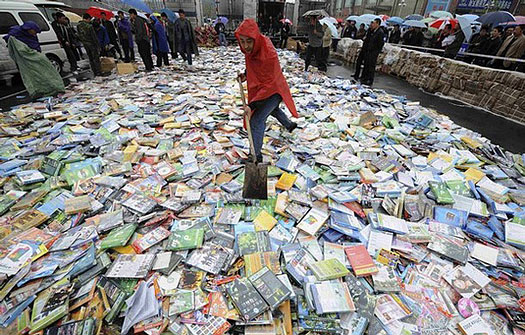
2 · Walter Benjamin — The Work of Art in the Age of Mechanical Reproduction
(a) Benjamin, W. (1969) ‘The Work of Art in the Age of Mechanical Reproduction’, in Arendt, H. (ed.) Illuminations. Translated by H. Zohn. New York: Schocken Books, pp. 1–26. (Originally published 1935.)
(b) Even the most perfect reproduction of a work of art is lacking in one element: its presence in time and space, its unique existence at the place where it happens to be.
(c) Benjamin describes mechanical reproduction as the historical event that emptied the artwork of aura — the specific weight of being one thing in one place. My project starts where his ends. The image-objects I work with have no original to lose: a meme is born already as a copy. And yet they are not aura-less. What collects on them is something else — a record of having been handled, screenshotted, cropped, reposted, run through one platform’s compression and then another.
3 · Daniel Rubinstein & Katrina Sluis — The Digital Image in Photographic Culture: Algorithmic Photography and the Crisis of Representation
(a) Rubinstein, D. and Sluis, K. (2013) ‘The Digital Image in Photographic Culture: Algorithmic Photography and the Crisis of Representation’, in Lister, M. (ed.) The Photographic Image in Digital Culture. 2nd edn. London: Routledge, pp. 22–40.
(b) The distinction between photography as an archive of memory and photography as an image of time in crisis allows us to suggest that the technologies that create interactive image systems also threaten photography’s representational paradigm through the production of a computational image. As we will explain in this chapter, the digital image is an image/software machine that operates on several levels at once, some visual, others computational, operating within media ecologies involving both human and non-human actors.
(c) Rubinstein and Sluis argue that the photograph, in the era of networked computation, has become less an index of the world and more a product of algorithms. The “crisis of representation” they describe is not about image quality but about what an image now is: a computational event subject to continuous processing. This reframing supports the move I am trying to make in my project. When I send a photograph of a CSM lamp through WeChat, the file that arrives on my friend’s phone is not simply my photograph slightly degraded; it is an image that has been reconstructed by the platform’s compression algorithm. Rubinstein and Sluis help me articulate why it is insufficient to treat this as a technical nuisance: the algorithm is producing the image, not merely transporting it. My iterations document this production.
4 · Limor Shifman — Memes in Digital Culture
(a) Shifman, L. (2014) Memes in Digital Culture. Cambridge, MA: MIT Press.
(b) Shifman defines an internet meme as “a group of digital items sharing common characteristics of content, form, and/or stance, which were created with awareness of each other, and were circulated, imitated, and/or transformed via the internet by many users.
(c) Shifman’s definition is the one I am taking the most operational use from. Two things in it matter directly to the archive. First, the meme is not a single image but a family of items — which is why my fossils sometimes preserve a lineage rather than a single specimen. Second, Shifman’s three modes — circulated, imitated, transformed — give me a vocabulary for the soft tags I attach to each fossil (provenance, spread, condition, template affordance).
5 · Rosa Menkman — The Glitch Moment(um)
(a) Menkman, R. (2011) The Glitch Moment(um). Amsterdam: Institute of Network Cultures (Network Notebooks 04). Available at: https://networkcultures.org/_uploads/NN%234_RosaMenkman.pdf (Accessed: 23 April 2026).
(b) “A glitch is a wonderful interruption that shifts an object away from its ordinary form and discourse, towards the ruins of destroyed meaning.”
(c) Menkman takes a clear position: the compression artefact is not noise to be eliminated but a site of critical attention — the moment where an otherwise invisible infrastructure becomes readable. This is the position my documentation also takes. I am not recording platform circulation to lament quality loss, nor to aestheticise it. Menkman lets me distinguish my project from two nearby traps I kept sliding into during Week 1: the nostalgic “degradation is beautiful” move, and the technical “compression is a problem to optimise” move. My position is closer to hers.
6 · Aria Dean — Poor Meme, Rich Meme
(a) Dean, A. (2016) ‘Poor Meme, Rich Meme’, Real Life Magazine, 25 July. Available at: https://reallifemag.com/poor-meme-rich-meme/ (Accessed: 23 April 2026).
(b) Like the poor image, the meme finds its home only in this circulation — its true content is the many bumps and bruises that have occurred along the way. It is a copy without an original — a copy of a copy of a copy, and so forth. For better or worse, a meme asks instead to be considered as its total sum presence in circulation.
(c) Dean extends Steyerl’s argument from the art image to the meme — a form whose visual language is shaped directly by the infrastructure of repeated compression, screenshotting, caption-editing, and re-upload. Her essay gives me a vocabulary for a specific visual register I keep encountering in my iterations: the “deep-fried” register, where colour saturation over-boils, JPEG blocks surface as texture, and the image appears to have eaten the history of its own distribution. Dean lets me treat this register as content rather than aesthetic accident. A deep-fried image of a CSM lamp is not a failed image; it is an image that has accumulated the traces of every platform it has passed through.
References:
Steyerl, H. (2009) ‘In Defense of the Poor Image’, e-flux journal, (10). Available at:
https://www.e-flux.com/journal/10/61362/in-defense-of-the-poor-image/
(Accessed: 24 April 2026).
Benjamin, W. (1969) ‘The Work of Art in the Age of Mechanical Reproduction’, in Arendt, H. (ed.) Illuminations. Translated by H. Zohn. New York: Schocken Books, pp. 1–26.
Rubinstein, D. and Sluis, K. (2013) ‘The Digital Image in Photographic Culture: Algorithmic Photography and the Crisis of Representation’, in Lister, M. (2013) The Photographic Image in Digital Culture. 2nd edn. London: Routledge, pp. 22–40.
Shifman, L. (2014) Memes in Digital Culture. Cambridge, MA: MIT Press.
Menkman, R. (2011) The Glitch Moment(um). Amsterdam: Institute of Network Cultures (Network Notebooks 04). Available at: https://networkcultures.org/_uploads/NN%234_RosaMenkman.pdf (Accessed: 23 April 2026).
Dean, A. (2016) ‘Poor Meme, Rich Meme’, Real Life Magazine, 25 July. Available at: https://reallifemag.com/poor-meme-rich-meme/ (Accessed: 23 April 2026).
Leave a Reply