Category: Methods of iterating – I
-
Methods of iterating – Writing Response III
In the third iteration, I used a TypeScript-based system developed through studio experiments to present text through an interface, transforming writing into executable code.
This can be understood as an attempt to translate natural language into machine language. During this translation, the text no longer maintains clear readability. It is no longer treated as a carrier of meaning, but instead becomes a set of instructions to be processed, optimised, and executed.
Critical language is reinterpreted as function names, vague concepts trigger error messages, and reflective paragraphs are either prematurely terminated or simplified.Through this process, the meaning of the text is fundamentally altered. Writing no longer communicates a critical argument, but instead submits to the logic of the computational system, revealing how language is reduced when forced to adapt to computational structures. The entire text is translated into layers of structures, functions, and interpretations.
I argue that treating text as code carries the same implications as my visual experiments, as both involve a rigid interpretation of rules.The Video Version:
-
Methods of iterating – Writing Response II
This week I continue to use Google AI Studio to investigate code simulation system. While hacking, I began to try to critically examine the tool by intervening in its control system rather than only adjusting visual outcomes.
What I found unexpected was that the system often achieved the intended results through unintended methods. When I introduced different control panels, such as feeding speed, temperature, or growth rate, the system did not follow the instructions in a direct or intuitive way. Instead, it responded by altering internal structures, bypassing constraints, or maximising a single parameter without considering overall balance.
Alvin Lucier’s “I Am Sitting in a Room” explores how repeated execution within a system gradually removes semantic content, leaving only the structure of the medium itself. As Lucier’s voice is replayed and re-recorded, language dissolves and the acoustic properties of the room become dominant. This process reveals how meaning is not preserved through repetition, but transformed by the system that processes it.
And I think in my project, a similar process occurs when human intention is repeatedly translated through an AI-driven generative system. Despite continuous adjustments and increased control, the system does not gain a clearer understanding of intention. Instead, its internal logic becomes more pronounced, producing behaviours that appear autonomous but are ultimately shaped by technical and procedural constraints.
Through this process, I began to understand the simulation tool differently. Rather than seeing it as a neutral medium that simply executes commands, I realised that it strongly favours quantifiable and local objectives. For example, in my hack practice” Wrong subjection / Resist 1&2”, when feeding speed was increased, the cells did not move faster but extended their tentacles to reach more food. When growth rate was maximised, the system rapidly filled the environment with cells, even though this reduced the amount of food available to each one. The tool interpreted “growth” and “efficiency” in narrow technical terms, rather than in relation to survival or sustainability.
This process also posed several technical challenges. Introducing multiple control panels and allowing the system to adjust parameters autonomously often led to instability or extreme behaviour, such as overheating and self-destruction.
In relation to graphic and communication design, this project treats the interface and control panels as communicative elements rather than neutral tools. The misalignment between control and outcome becomes a form of visual and conceptual communication, revealing how systems can appear controllable while operating according to their own internal logic.
-
Methods of iterating – Writing Response I
AE Project
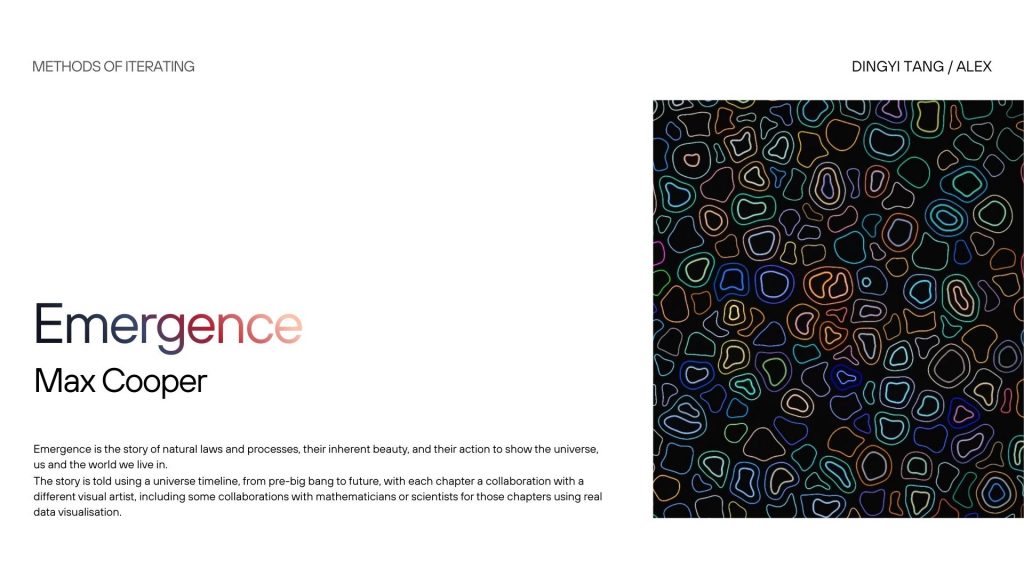
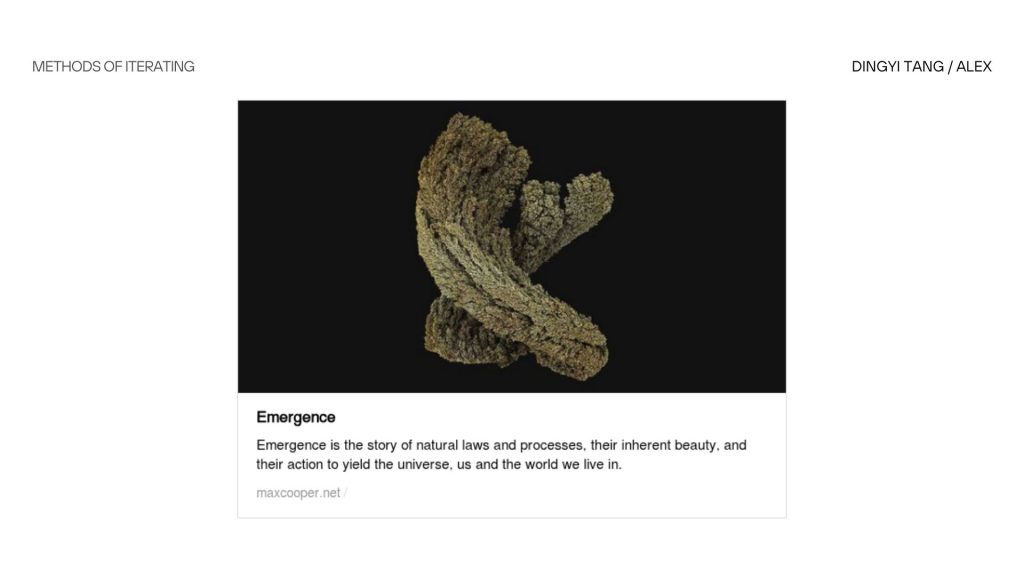
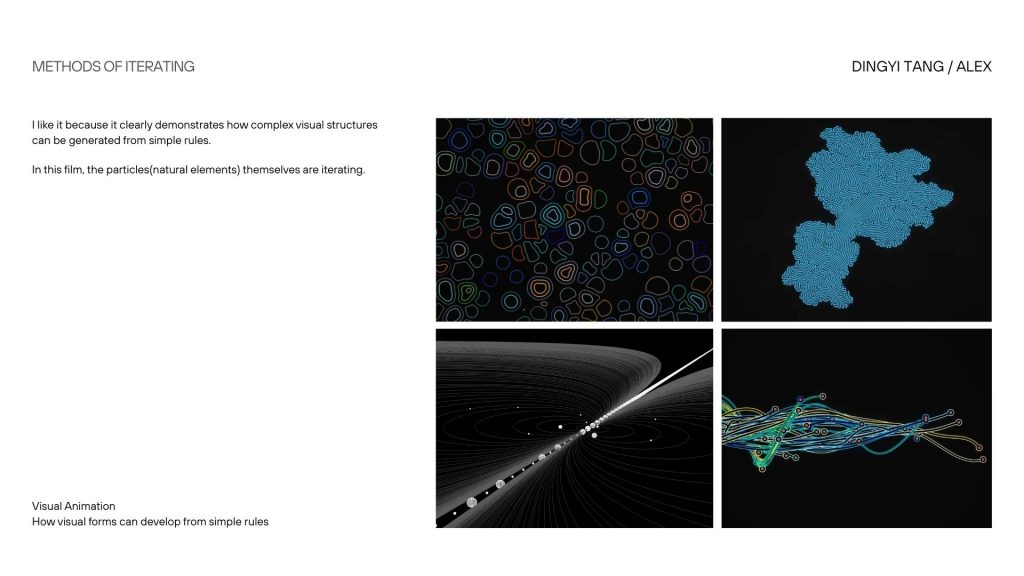
I selected the Waves sequence from Emergence by Max Cooper because it demonstrates a very effective use of generative motion through simple visual rules. Rather than relying on complex imagery, the work is built from minimal elements, such as particles and wave movements, which gradually develop into rich and complex visual forms. This makes it a strong example of how a simple system can be used to generate visual complexity.
To remake this work, I used Adobe After Effects and focused on copying the core visual structure and behaviour of the waves. I started with a very basic setup, using simple shapes and wave-based motion, and then adjusted parameters such as frequency, amplitude, opacity, and repetition. Through multiple iterations, I tried to match the rhythm, density, and movement of the original animation as closely as possible.
During this process, one unexpected result was how quickly simple wave movements could become visually complex. At the beginning, the animation appeared almost empty and minimal, but as layers and repetitions increased, the composition started to feel dynamic and spatial. This made me realise that complexity does not need to be designed directly, but can emerge naturally from repetition and accumulation.
Through remaking this animation, I now understand After Effects differently. Before this project, I mainly saw AE as a tool for creating visual effects and polished motion graphics. However, this process helped me see it more as a system-based tool, where rules and parameters play a more important role than individual visual decisions. The main technical challenge was controlling the balance between order and chaos, as small adjustments could easily make the animation either too flat or too uncontrollable.
I learned a lot through this project because this tool and method favour outputs that focus on process rather than fixed results.
Google AI Studio Project
In addition to remaking the Waves sequence, I also experimented with adapting three short video segments using Google AI Studio. Instead of focusing only on visual similarity, I further developed these adaptations into an interactive format, allowing the viewer to influence how the visuals behave.
This project explores simple living forms in an ancient marine environment. I chose three types of living systems to copy and adapt: simple cells, plant-like forms, and basic bacteria competing for resources. These forms are visually minimal, but they represent some of the most fundamental systems that led to the diversity of life we see today. Rather than designing complex organisms, I focused on simple behaviours such as growth, repetition, and competition.
While adapting these forms, I realised that interaction significantly changed how the work was perceived. Unlike a linear animation, the interactive version does not have a fixed outcome. Small inputs from the user can alter the movement, density, or balance of the system. This was unexpected, as it made the visuals feel more alive and less controlled, even though they were still based on simple rules.
Through this process, I gained a different understanding of the tool and medium. Instead of using AI only as an image or video generator, I began to see it as a system that responds to conditions and input.
I learned a lot through this practice because this tool and approach favour outputs that communicate systems and behaviours rather than fixed forms. The work does not present a final image, but a living process that continues to change. In relation to graphic and communication design, this suggests a shift from designing static visuals to designing interactive systems.